

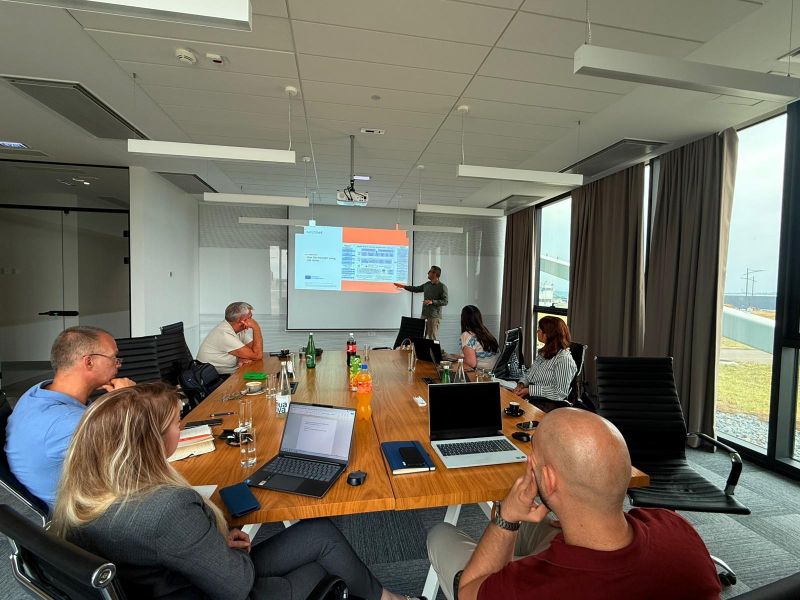
The Serbian stakeholder group from the WELDNET EU Project held its country-level kick-start of the development process
Guided by the local representation of EIT Manufacturing in Serbia (Adrian Solomon), the partners co-created the local roadmap for setting up a cohesive ecosystem that would enable the region of Sumadija & Pomoravljie to excel in upskilling and preparing future workforce via Centres of Vocational Excellence (COVEs) in circular material welding and predictive maintenance systems.
Iva Pavlovic from Helixconnect presented a detailed skills ecosystem foresight methodology that will be used to envision the blueprint of the future COVE. Nenad Popovic & Natasa Djordjevic from REDASP Sumadija and Pomoravlje introduced their support for public-private partnership strategy while Aleksandra Mitrovic & Sinisa Kojic from Srednja škola “Knez Aleksandar Karađorđević” Kragujevac aligned the needs with the priorities of the vocational education sector in Serbia.
With the support of the strongest industrial park in the region MIND – Milanović Industries Group (Teodora Pavićević & Stefan Vojinovic) we are paving a strategy that will serve regional labor needs.
This region is important because here are roots of Serbian industry, and center of the automotive industry in the Balkans, European pan corridor X, Industrial tradition, cc 20.000 business active, University with 12 faculties, National Data Center and MIND – Milanović Industries Group (leading industrial partner and WELDNET EU Project partner) together with REDASP Sumadija and Pomoravlje and .
In this context, WELDNET EU Project has the general aim to develop a network of 5 centres of vocational excellence – COVEs (in particular regions from Greece (Central Macedonia), Romania (West Region), Austria (Multi-region), Serbia (Sumadija & Pomoravlje), Spain (Valencia)) capable to trigger regional skills ecosystems in the field of circular material welding & preventive maintenance in automotive manufacturing by providing long-term sustainable upskilling mechanisms (IVET/CVET) for workers/learners (including those with disabilities or from social groups at risk such as minorities/refugees). The COVEs will serve current & emerging regional industrial needs (according to the smart specialisation strategy of each region).
What will we offer soon to the regional skills ecosystem ?
* Training and certification opportunities
* VET institution self-diagnosis tool
* Support to VET institutions to transform and become leaders of their skills ecosystems
* Learner mobility options